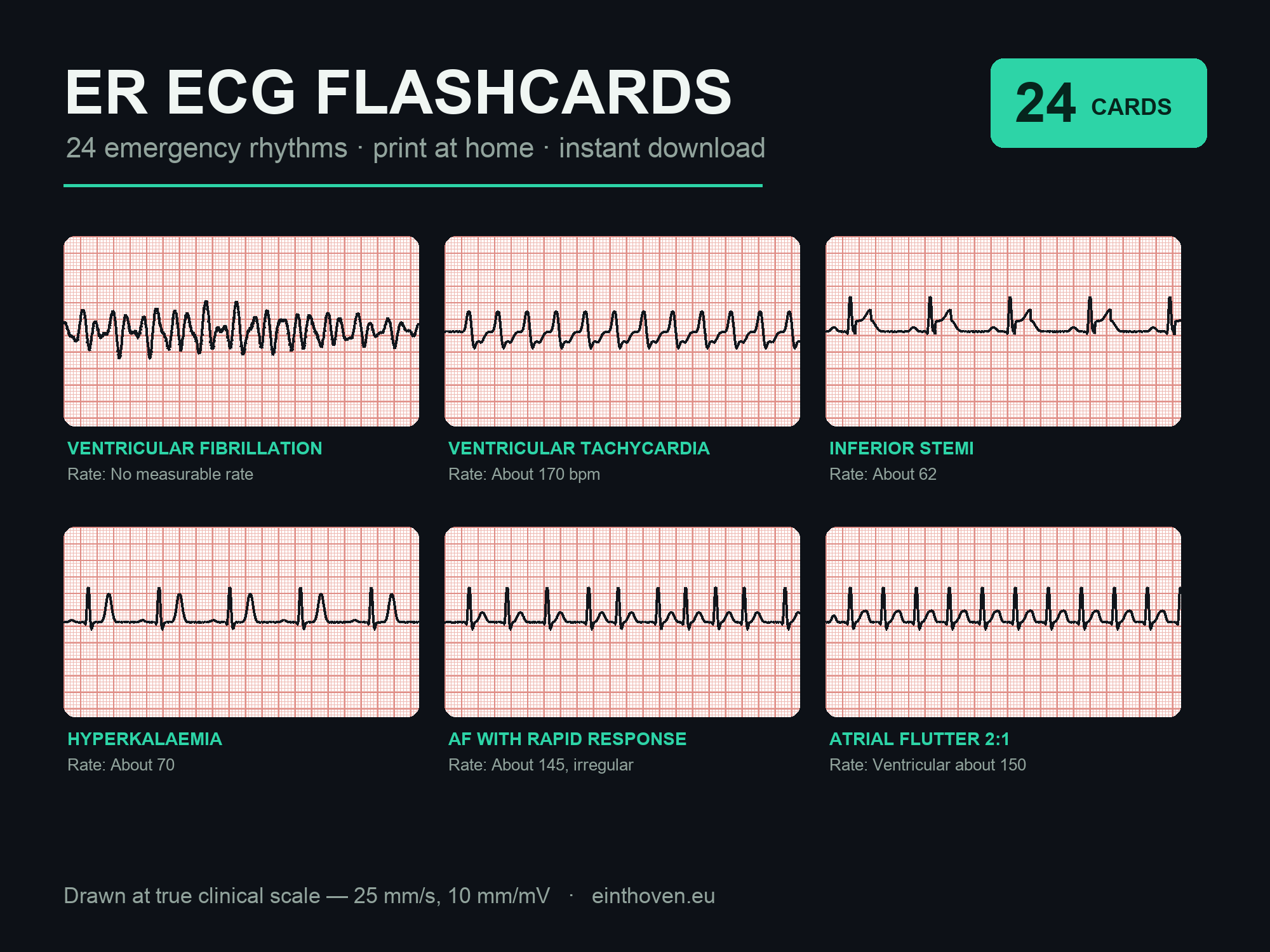
Built for the rhythms you have to name in seconds — in resus, on a cardiac arrest call, or in an exam where the strip is the whole question.
Every trace is drawn at true clinical scale: 25 mm/s and 10 mm/mV on standard ECG paper. If you put calipers on these cards, the intervals measure exactly what they would measure on a real printout.
What is on each card
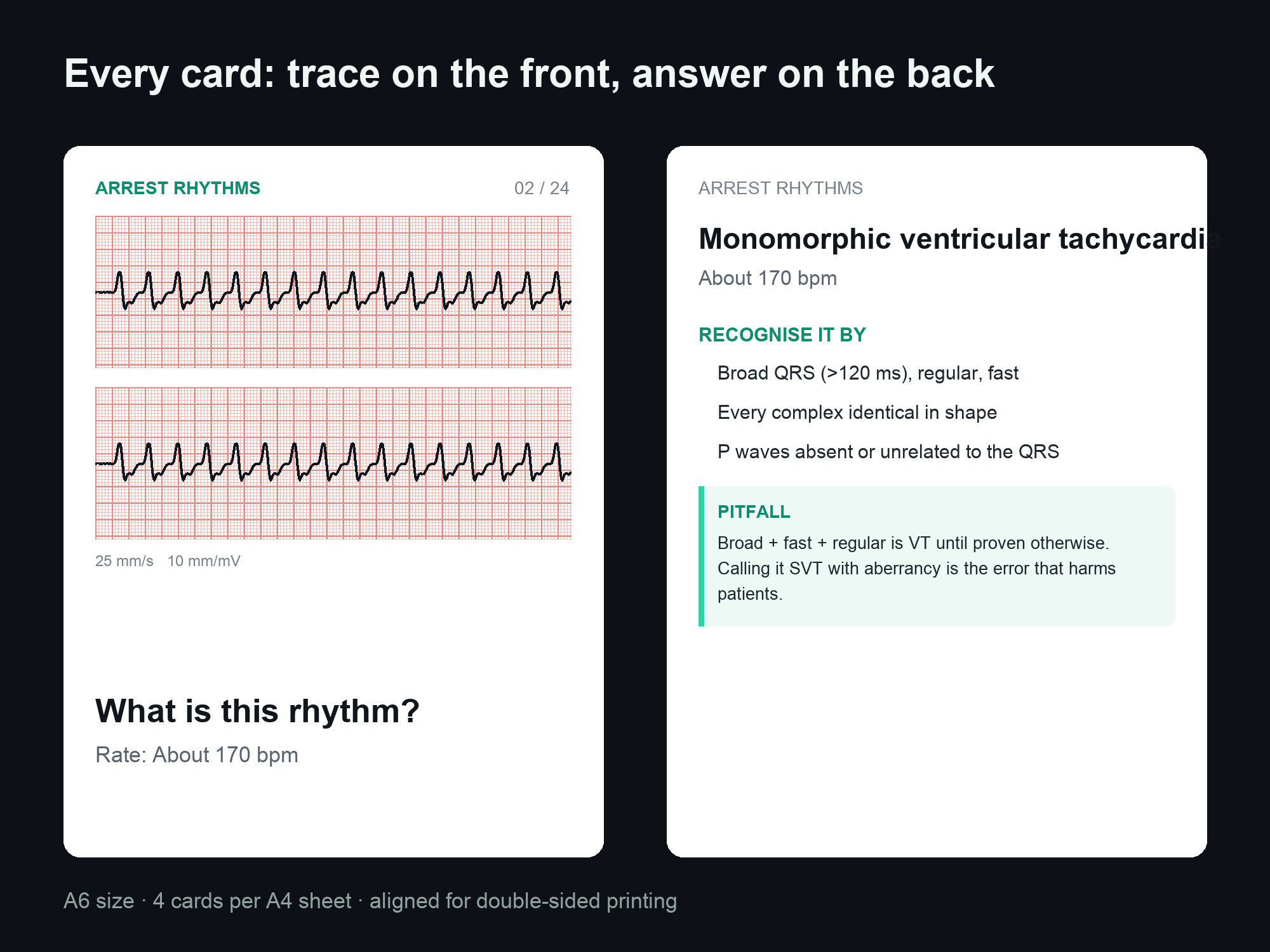
Front — the rhythm strip and the rate. Nothing else, so you commit to an answer before you see it.
Back — the diagnosis, three recognition features, and the pitfall that makes that particular rhythm easy to miss or misread.
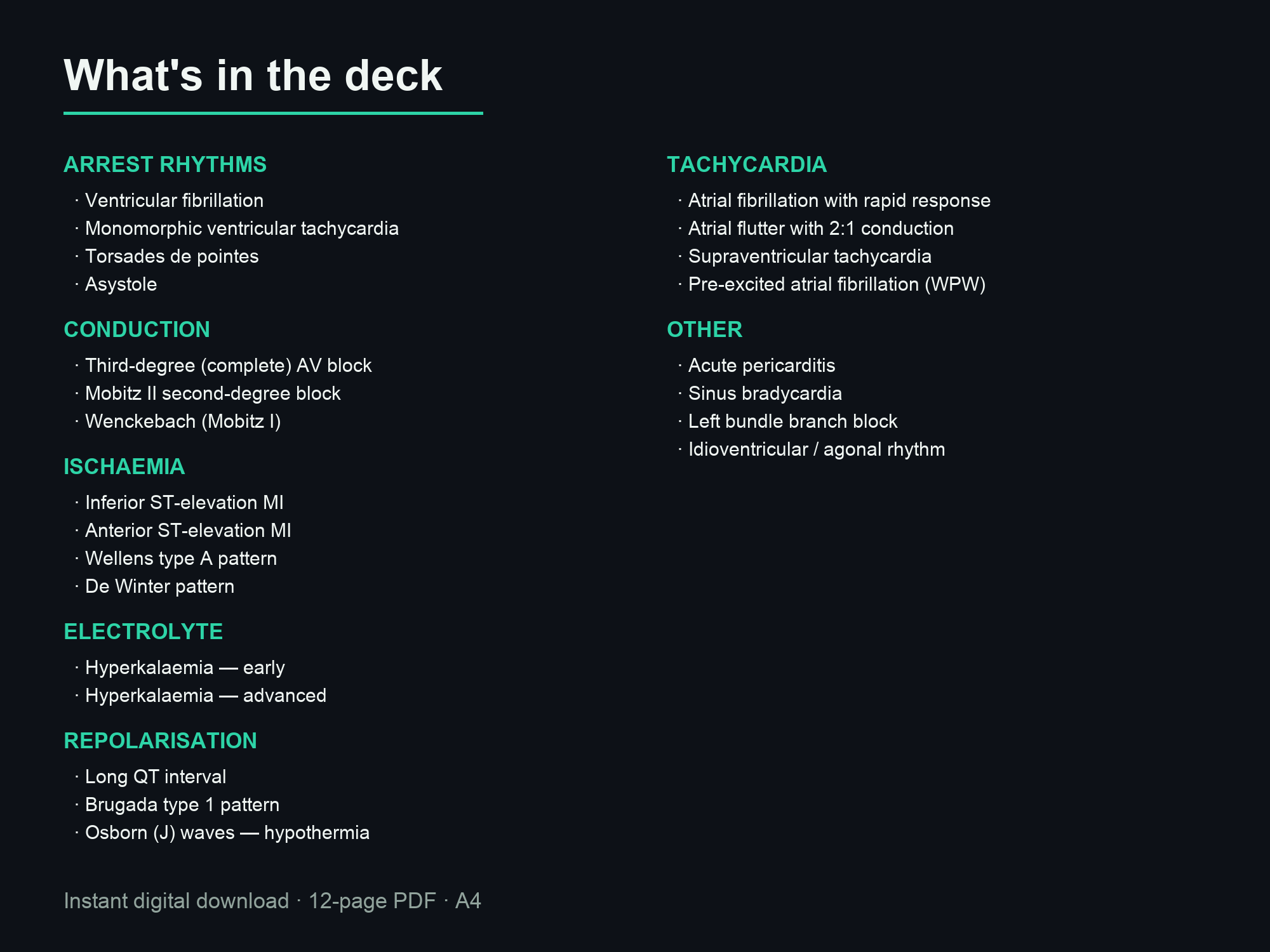
The 24 rhythms
- Arrest — ventricular fibrillation, monomorphic VT, torsades de pointes, asystole
- Conduction — complete heart block, Mobitz II, Wenckebach
- Ischaemia — inferior STEMI, anterior STEMI, Wellens pattern, de Winter pattern
- Electrolyte — early hyperkalaemia, advanced hyperkalaemia
- Repolarisation — long QT, Brugada type 1, Osborn waves in hypothermia
- Tachycardia — AF with rapid response, atrial flutter 2:1, SVT, pre-excited AF in WPW
- Other — acute pericarditis, sinus bradycardia, left bundle branch block, idioventricular rhythm
How to print
Print double-sided on A4, flipping on the long edge. The backs are already mirrored so each answer lands behind its own question. Cut along the guides for four A6 cards per sheet. Card stock works well but plain paper is fine.
Written against published guidance
Recognition features and pitfalls are written against the 2022 ESC guidelines on ventricular arrhythmias, the 2024 ESC atrial fibrillation guidelines, and the AHA/ACCF/HRS ECG standardization series published in JACC. The cards teach recognition. They contain no drug doses and no treatment protocols, because those belong to your local guidelines, not to a flashcard.
Practise the same traces free
Einthoven — gamified ECG practice
The traces come from the engine behind this site. The first three need no account, so you can drill on screen and revise on paper.
Try a round →